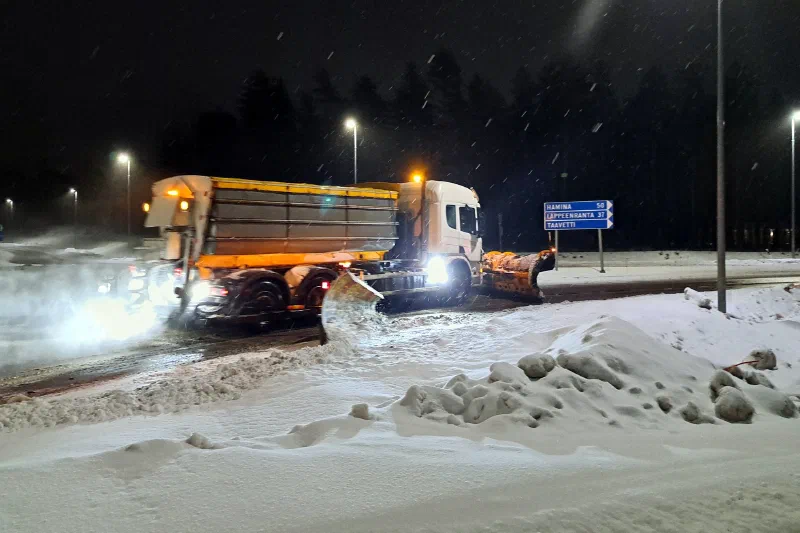
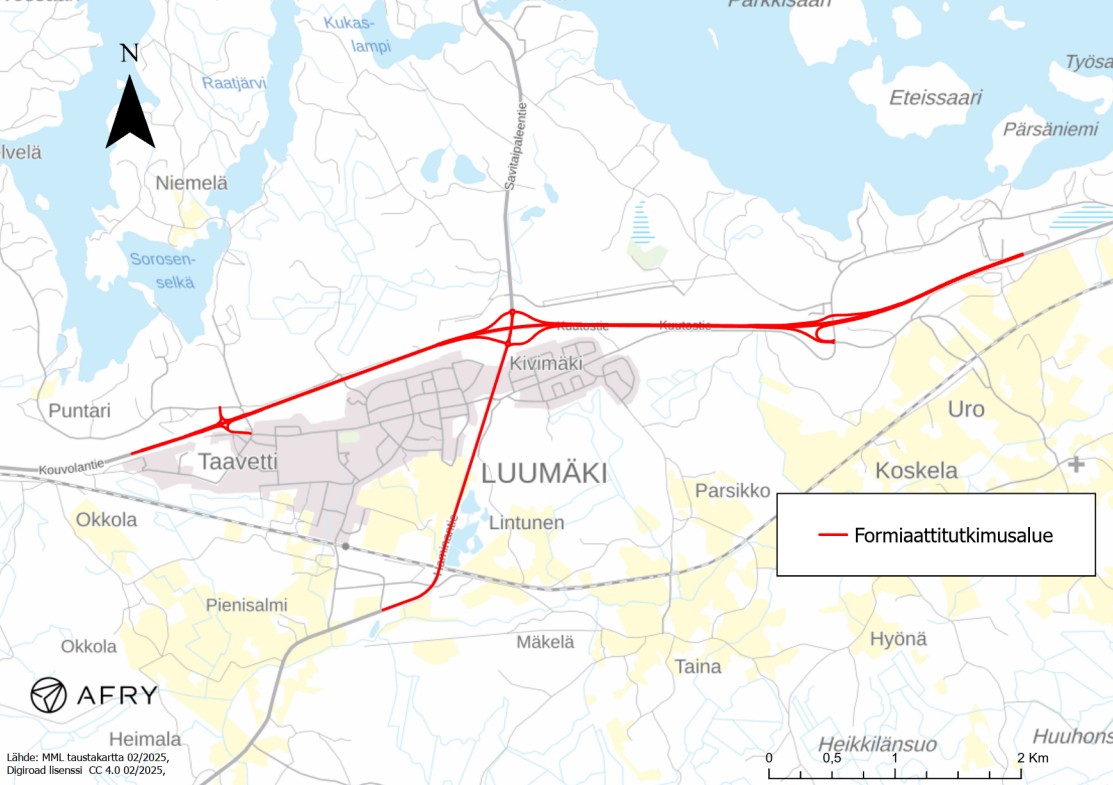
Through the winter of 2024–25, one maintenance truck in south-eastern Finland carried no road salt. On about 25 km of Highway 6, Road 26 and their ramps at Luumäki it ploughed and spread formate, and nothing else. Not even the grit had salt in it. AFRY and SirWay studied the trial for the Finnish Transport Infrastructure Agency (FTIA): could formate keep a busy main road as safe as salt does, and at what cost?
Why not salt?
Salt is cheap, quick and well understood. But the chloride runs off the road. On groundwater areas it raises the chloride content of the water, corrodes water-intake pipes and household plumbing, and eats into concrete such as bridge edge beams. Salt on the road also draws elk to the roadside in winter, which raises the risk of collisions.
Luumäki has several groundwater areas. Protection structures had been built along the road, with bentonite mats in the embankment and ditches that lead salty runoff to the storm drains, yet chloride levels stayed high.
Formates melt ice and snow like salt does. Sodium formate is used as granules, potassium formate as a solution. In the soil they break down into carbon dioxide and water before they reach the groundwater. A 50% potassium formate solution freezes only at −58 °C. Airports already use formates because chlorides are not allowed there.
The trial
Highway 6 at Luumäki is in the highest winter maintenance class, and its ramps and Road 26 are in the next one. It is a heavy-traffic route to the port of Hamina-Kotka. The friction requirement is at least 0.30 on FTIA’s scale.
- The road: 7.4 km of Highway 6 in both carriageways, 4.2 km of Road 26 and 6.3 km of ramps, 25.3 km in all.
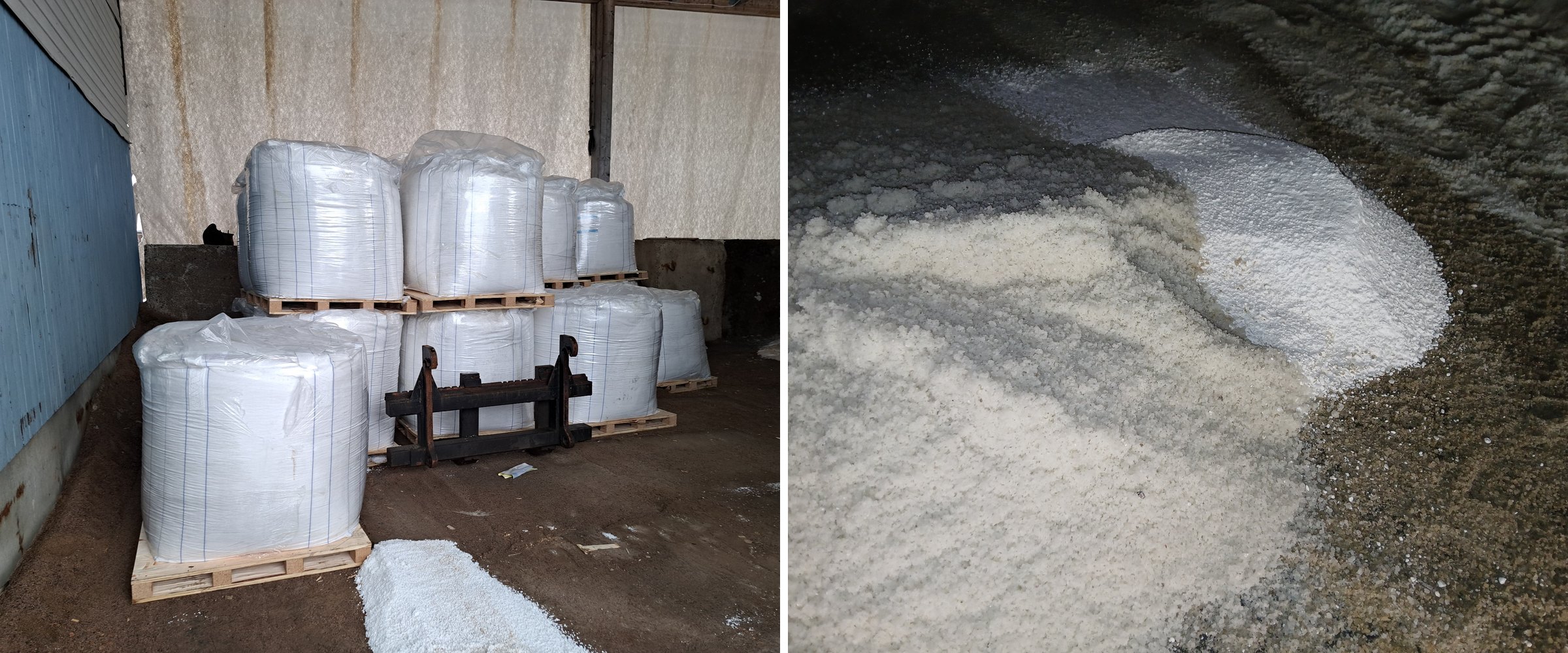
- The material: 203 tonnes of sodium formate granules (99%), 19 tonnes of a 40% potassium and sodium formate solution and 31 tonnes of a 50% potassium formate solution.
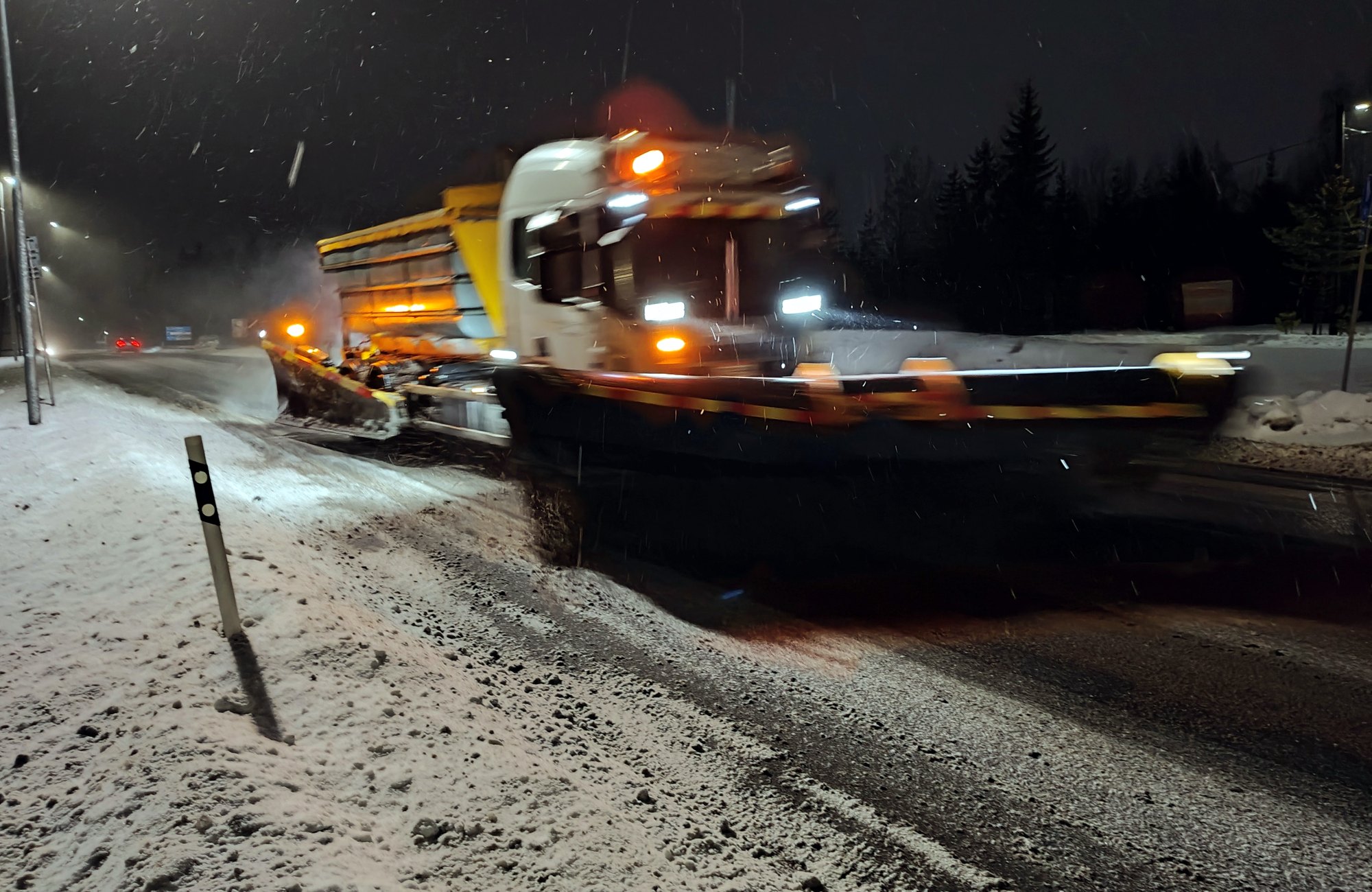
- The truck: a 26-tonne three-axle truck with front and side ploughs, an underbody blade and an automatic spreader. It served only the trial roads and went out for every anti-skid treatment. Where snow was packed onto the road, it was removed mechanically.
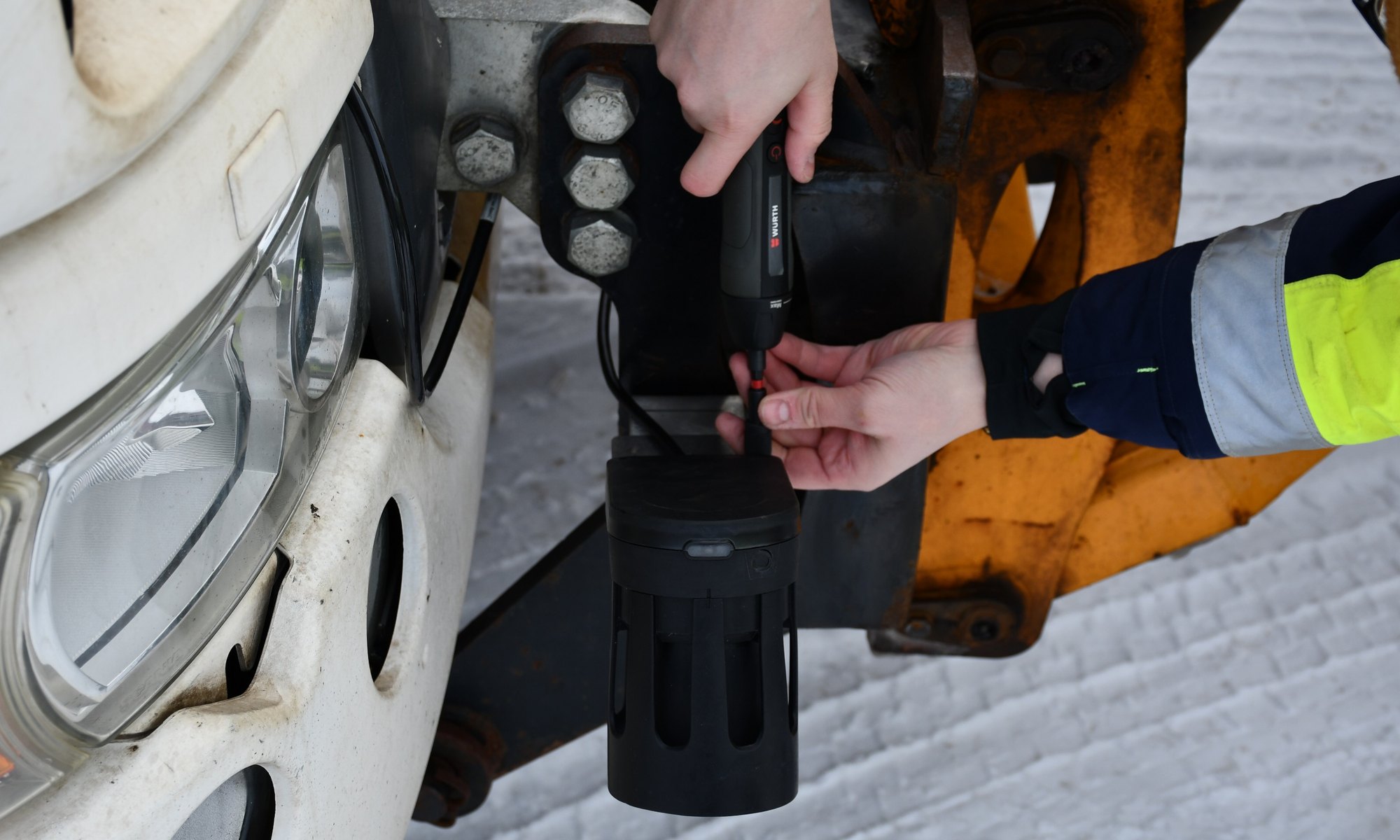
- The data: optical friction sensors on a maintenance vehicle and on a supervisor’s car, recording friction and road condition. The spreading records came from the contractor’s system.
SirWay’s part was the data. The friction readings come in intervals of about 10 metres, and the spreading records give a dose per square metre for each section. We joined the two by place and time, so that each road segment had its friction before treatment, the type and dose of formate, its friction after treatment and the time between them. Sensor errors were filtered out, for example the readings of about 0.1 that a meter gave when snow or slush blocked it. We then compared groups with Tukey’s HSD test and fitted regression models by road condition.
Result 1: friction met the requirement
The contract supervisor at the ELY Centre found that the formate area met the quality requirements all winter. Road users noticed nothing. There were two complaints about the formate area, both about slippery junctions on Highway 6, and the feedback overall was lower than normal.
The data showed how fast formate works:
- Icy or snowy roads: friction rose clearly within about 25 minutes of spreading.
- Slushy roads: within about 50 minutes.
- Wet roads: within about 75 minutes, although friction on wet roads stayed above 0.4 anyway.
The regression models give the effect of the dose. On icy, snowy or wet roads, each gram per square metre of sodium formate raised friction by about 0.025, and each millilitre per square metre of potassium formate by about 0.04. On slush, potassium formate worked much better: about 0.09 per ml/m², against 0.015 per g/m² of sodium formate. Formate also lasts long on the road, and it handled black ice better than salt, with less salt spray from traffic.
From the models, the report gives indicative doses of the two formates spread together to reach a friction of 0.30:
| Friction before | Sodium formate (g/m²) | Potassium formate (ml/m²) |
|---|---|---|
| 0.05 | 5 | 7 |
| 0.10 | 5 | 5 |
| 0.20 | 2.5 | 2.5 |
Result 2: in falling snow, salt is faster
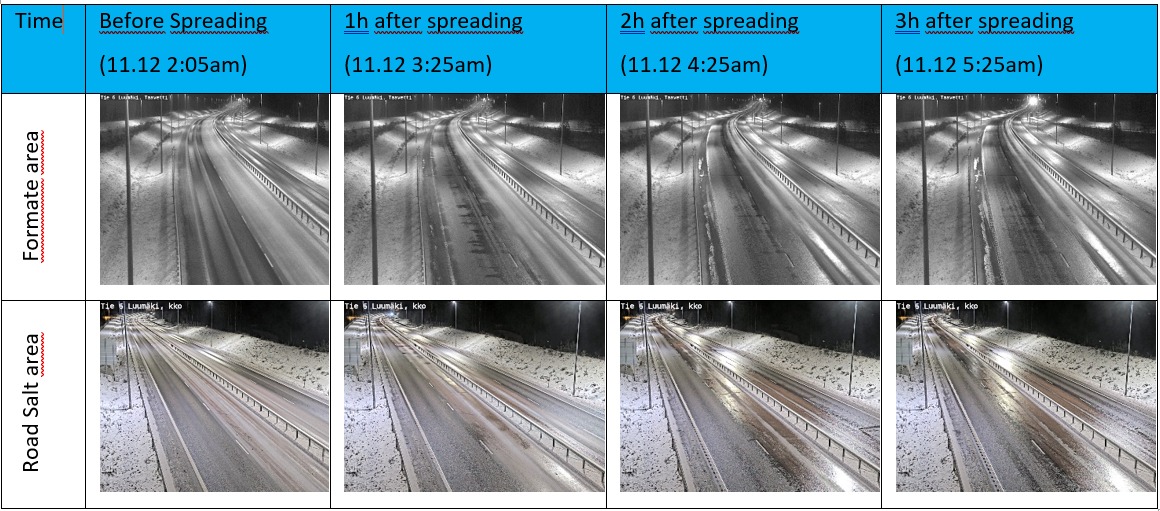
The road weather cameras tell the rest. On the morning of 5 March 2025, both sections were treated in advance before snowfall. An hour later, the salted section 4.5 km away was bare. On the formate section, the overtaking lane was still white.
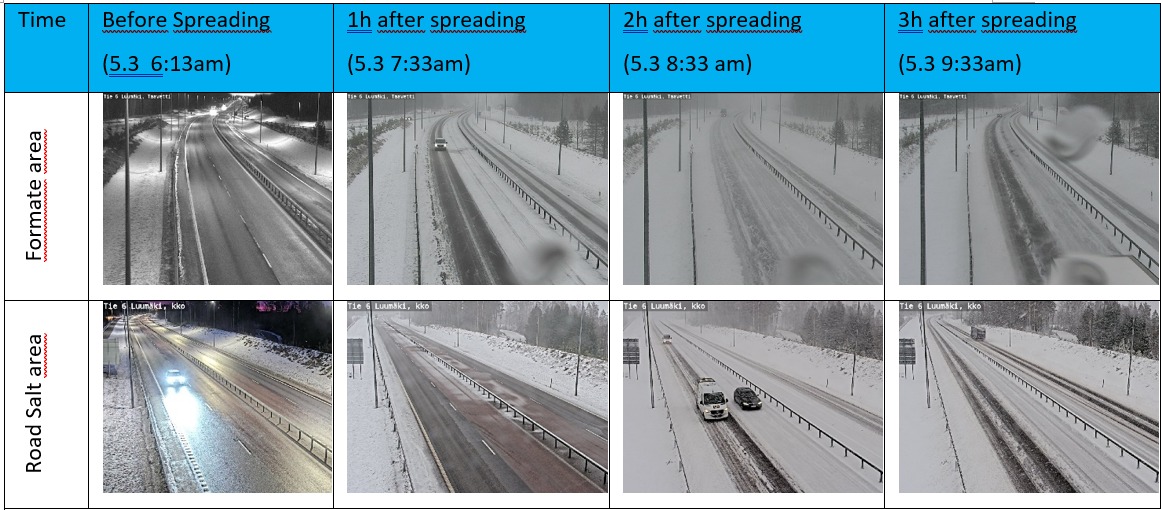
Formate stays on top of snow and needs traffic to work it in. Salt spread across the whole carriageway; formate hardly spread at all. The overtaking lane and the shoulders, which carry little traffic, needed an extra ploughing round. In snow, the sodium formate granules needed to be driven over before they started to work, and with very little traffic the driver sometimes had to treat a section twice.
On ice and frost there was no visible difference.
Result 3: twelve times the cost
Formate costs several times as much as road salt per tonne, and the trial also needed its own truck, storage and loading.
The report estimates that the same winter with road salt would have needed about 20% less material. On that estimate, the formate cost roughly twelve times as much as the salt would have.
That comparison leaves out what salt costs elsewhere: water-intake pipes, plumbing, bridge edge beams, roadside trees and water life, and elk collisions. Nor does it count the protection structures that were built and still did not keep the chloride out.
Result 4: the equipment and the crew
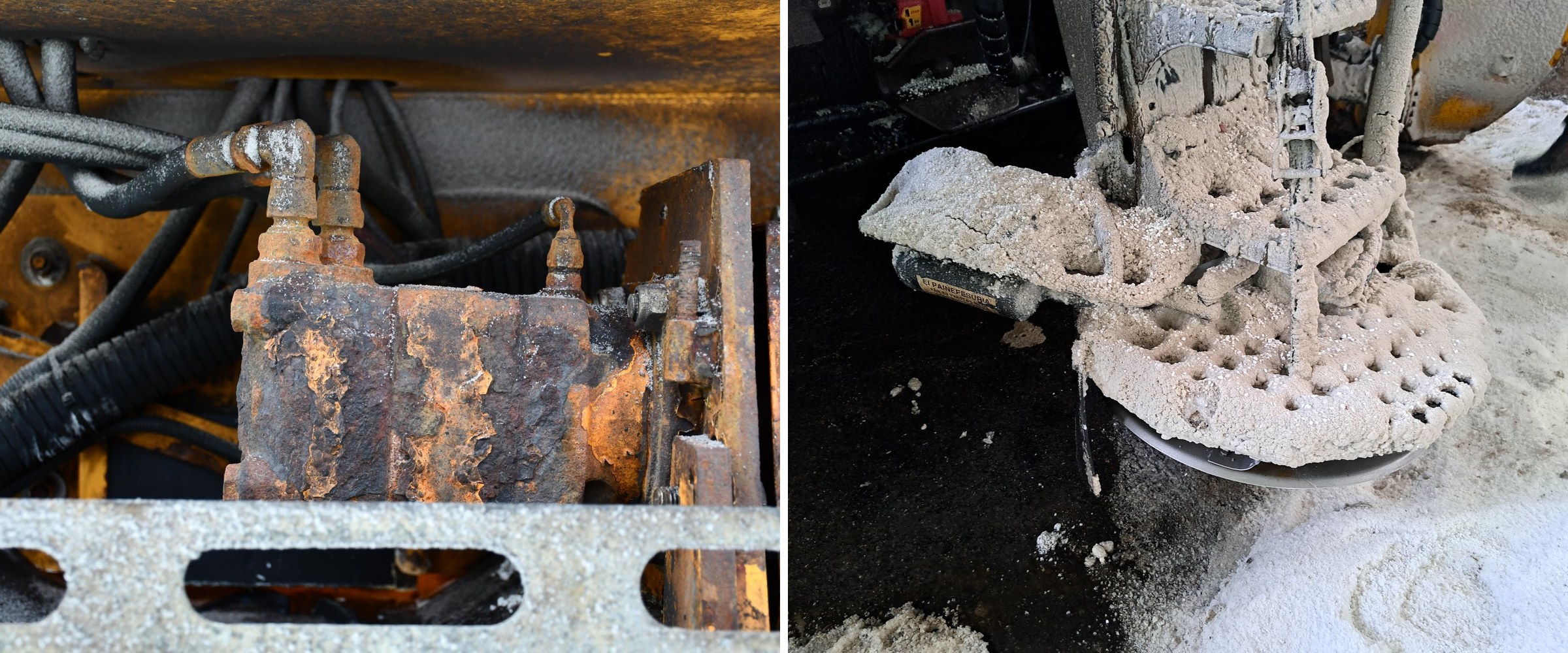
Earlier laboratory tests had found that potassium formate corrodes metal about as much as salt does. Sodium formate granules in the field told a different story. The spreader was a 2019 model with an almost flawless finish. Within one winter, its conveyor’s hydraulic motor corroded, a month-old gas spring was damaged and every bearing on the belt conveyor had to be replaced. Parts wore out much sooner than on the same model spreading salt.
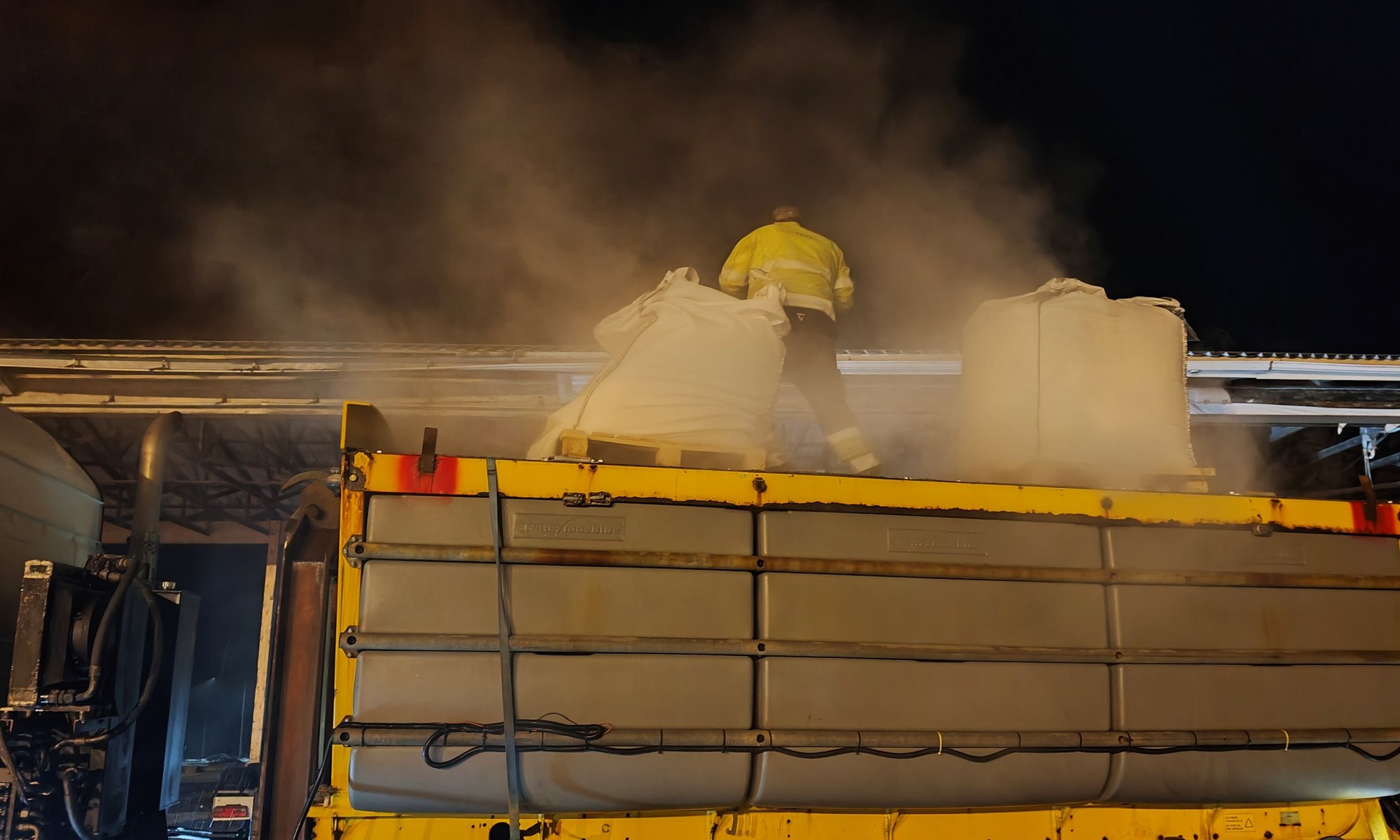
Dust was the common cause. The granules are finer than salt, so dust rose when the material was spread and when the 1,000 kg bags were cut open on top of the truck. It got into places that salt crystals do not reach, covered the truck’s warning lights and headlights, and got through clothing: two people had skin symptoms. Loading took about 20 minutes longer than with salt.
The driver’s verdict was clear. The formate area was slower and harder to maintain, and a route of normal length could not have been kept in condition this way. The supervisor saw the trial as a success on quality, but asked for the safety data sheet to be updated.
What would make it work
Formate can replace salt on a main road where the groundwater needs it. Four changes would bring the cost and the risks down:
- Dose by measured friction. Friction was often well above the requirement, and formate was still spread. The doses can come down without risking safety if they follow measured friction and road weather, segment by segment, with a stepless spreader.
- One truck, two silos. Areas where salt is restricted are usually short. A spreader with separate tanks for salt and formate could serve them on a normal route, instead of a dedicated truck.
- Handle it like salt. Load the granules from heaps with a loader, wet them to stop the dust, and keep people out of contact with the material.
- Compare it with protection. The next question is the payback: formate against groundwater protection structures, with the damage that salt does counted in.
The report recommends repeating the trial once the equipment problems are solved and dynamic, location-based dosing is possible.
Who did the work
The study was carried out by AFRY and SirWay for the Finnish Transport Infrastructure Agency, supervised by Jarkko Pirinen (FTIA), in the Lappeenranta maintenance contract. It was presented at TTP2026 in Finland and as paper 0046 at the PIARC World Winter Service and Road Resilience Congress in Chambéry, March 2026: Anti-skid treatment with formates, by Konsta Sirvio (SirWay), Markku Knuuti (AFRY) and Jarkko Pirinen (FTIA).